
A planning application in Ballarat, Bendigo or a small shire town is advertised under the same law as one in inner Melbourne. What changes is who does each part of the work, how the council has set its own procedure, and the practical side of getting a notice onto a frontage that may be hours away from the person managing the application. This article covers both: what the law and a few regional councils say, and what to sort out before a regional site visit.
The same law across the state
Public notice of a planning application in Victoria comes from the Planning and Environment Act 1987. When an application may cause material detriment to any person, the responsible authority can require notice to be given, and it decides how: letters to owners and occupiers, a sign on the land, a newspaper notice, or a combination. That applies in every municipality, metropolitan or regional.
What the Act does not do is set one statewide procedure for the physical sign. Councils publish their own guidance, and the written instruction issued for your application is what you follow.
Regional councils do it differently
Two regional cities show how far the arrangements can differ.
City of Ballarat. Ballarat's advertising policy, adopted by the council in April 2024, says its statutory planning team erects all signs on behalf of permit applicants. Signs are yellow, usually A2 (anywhere from A2 to A0 depending on the proposal), and generally placed at the centre of the site frontage within a metre of the public realm. They must be displayed for at least 14 continuous days. The applicant pays the advertising fees and must tell the council if a sign is removed or damaged; depending on when that happens, the period may be suspended or restarted once a replacement is up.
City of Greater Bendigo. Bendigo's published guidance describes a different split. The advertising package the council sends includes an A3 notice for the applicant to sign and place on site where a site notice is required, an A4 notice for the applicant to sign and post to adjoining owners and occupiers, and a statutory declaration to return to the council at the end. The advertising period is 14 days, and the on-site notice must be kept weatherproofed and in good condition throughout. A newspaper notice may also be required in a local paper.
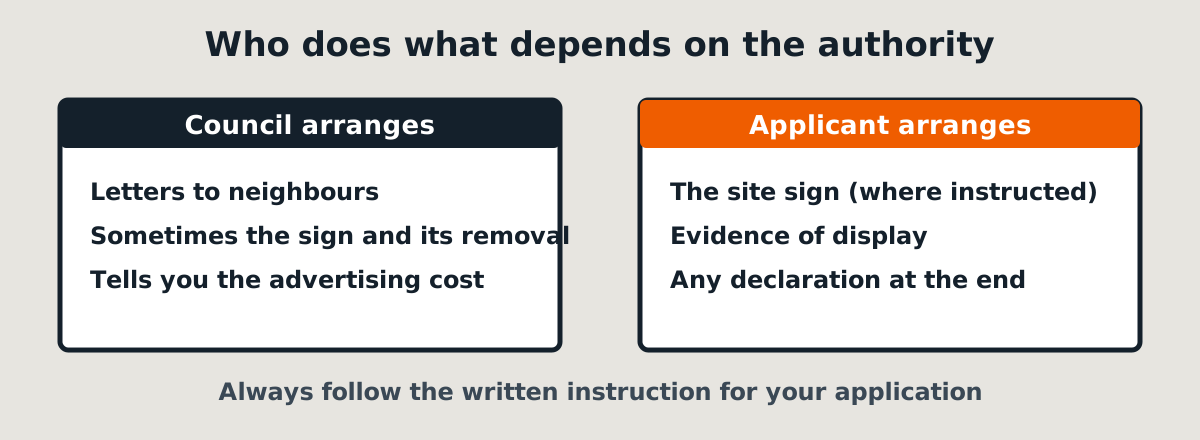
So in one regional city the applicant may never touch the sign, and in another the applicant is responsible for putting it up, keeping it in good condition and declaring that it was displayed. The same is true across metropolitan councils: our guide to who installs a planning notice explains how to read the instruction, and statutory declarations for planning notices covers the declaration itself.
| Question | Where to find the answer |
|---|---|
| Is a site notice required at all? | The council's written instruction for the application |
| Who erects it — the council or the applicant? | The instruction, and the council's published advertising guidance |
| Size, number and position of signs | The instruction (some councils set these in a policy) |
| How long it stays up | The instruction; check whether holiday periods are excluded |
| What to send back at the end | The instruction — often a statutory declaration |
| Who removes it | The instruction, or ask the council before taking it down |
What distance changes in practice
When the site is a long drive from the applicant, the architect or the planner, small gaps in the instructions become expensive. A missed gate code or the wrong frontage means another trip, and a delayed start can push the whole advertising period back.
Book early. Regional visits are planned around travel, so give the installer the council's instruction, the approved notice and the required start date as soon as you have them.
Describe the site properly. Rural and semi-rural properties often have long frontages, more than one road boundary, farm gates, unsealed access or no street number on the fence. Give the title or lot details, a map pin and a note of which road the council expects the notice to face.
Sort out access before the day. Locked gates, livestock, dogs and working machinery are normal on regional land. Tell the installer who to contact on the day and whether anyone needs to be present.
Agree the evidence you need. If nobody from the project will see the notice in person, the photographs are the record. Ask for a wide view showing the notice in its position, a close-up showing the text can be read, and the date of the visit. Our article on photographic proof of installation sets out a useful set.
Plan the middle and the end of the period. If the council needs to know when a sign is damaged, decide who will check it and how often. If the council does not remove the sign itself, decide who will, and only once the council confirms the period has ended.
Checking your council's arrangements
Search the council's website for "advertising a planning application" or "public notice", read the guidance it publishes, and keep it with the instruction for your application. If the two seem to differ, the instruction issued for your application is the one to follow, and the council's planning team can confirm anything that is unclear. Do not assume that a regional council works like the last metropolitan one you dealt with, or like the neighbouring shire.
If you need the physical work done
We install planning notices in Melbourne and regional Victoria from the instructions we receive, photograph them to a fixed checklist, check them during the period if you ask us to, and remove them at the end once it is confirmed. Where the council erects the sign itself, as Ballarat does, we can still help with the parts the instruction leaves to you. Request a quote with the site address, the council's instruction and your dates.
Related: Planning notice installation · Request a quote