
Port Phillip is one of the councils that splits the advertising work between itself and the applicant. This article summarises what the council's own published guidance says, so applicants and consultants know what to expect. It is a summary of a web page, not a replacement for the instructions the council gives for your application, and councils update their guidance.
When advertising applies
Port Phillip says a planning application is advertised when it could materially affect any person. The council can give notice by letter to nearby properties, by a notice displayed on the site, or both. Which of those apply to your application is set out in the instructions the council sends you.
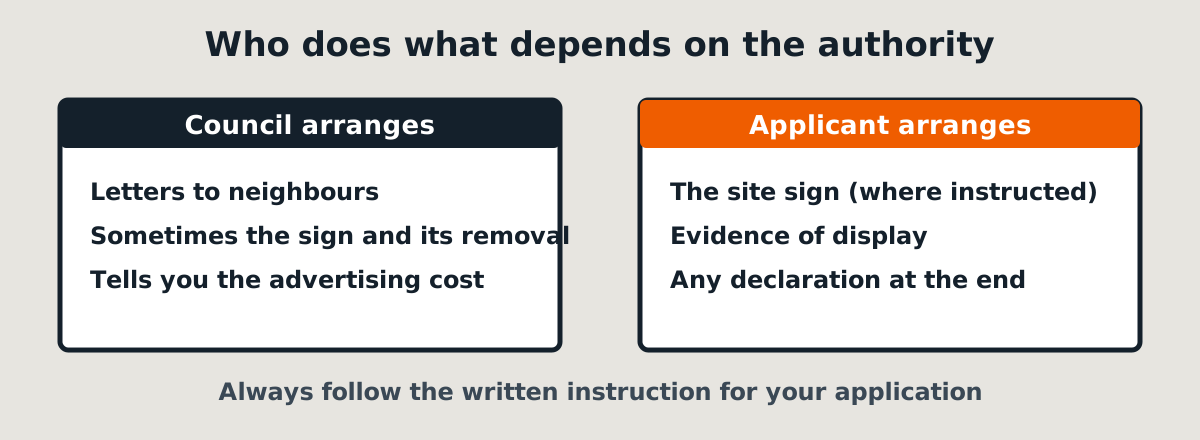
Who does what
According to the council's guidance:
| Task | Who |
|---|---|
| Notifying nearby properties | The council |
| Erecting the site notice | The applicant |
| Telling the applicant what advertising will cost | The council |
| Sending a statutory declaration at the end | The applicant |
The council's page does not say who maintains the notice during the display period or who removes it afterwards, and it does not mention a different period over the Christmas break. If your instruction does not cover those points, ask the council rather than assuming.
Display period and declaration
The guidance says the site notice must be displayed for at least 14 days. At the end of the advertising period the applicant must send the council a statutory declaration, which is a written statement confirming that the notice was displayed for the period. Objections must be lodged within the notice period, and the council considers them before it decides the application.
A declaration is a formal statement made by the person signing it. It has to reflect what actually happened, which is why an installation record is useful: dated photographs show what was installed and where, and notes about any damage or replacement help the person making the declaration describe the period accurately. Photographs do not replace the declaration, and an installer cannot sign it on the applicant's behalf.
Practical points for applicants
Keep the instruction with the job. Record the application number, the council's wording and the dates it gave you.
Plan the sign early. Because the applicant erects the notice, it needs to be printed, installed and photographed before the period starts, and the start date needs to match the instruction.
Check the notice during the period. If the sign is damaged or removed, record it and ask the council what it needs. Do not quietly replace it and assume nothing has changed.
Plan the end of the period. Decide who will check the notice, who will remove it once the council has confirmed that is appropriate, and who will prepare the declaration.
Plans for advertised applications can be viewed through the council's online portal, where the application tracking list can be searched by application number or address.
If you need the physical work done
We install planning notices across Victoria from the instructions we receive, photograph them to a fixed checklist, check them if you ask us to, and remove them at the end. Request a quote with the council's instruction, the approved notice and your dates.
Related: Planning notice installation · Request a quote