
Every planning instruction you receive, including the one that says a notice must go on the land, comes from a body called the responsible authority. Knowing who that is for a particular property tells you whose instructions to follow, whose website to check, and who to ask when something is unclear.
What a responsible authority is
The responsible authority is the body that administers a planning scheme and decides planning permit applications for an area. For most properties it is the local council. In some cases it is the Minister for Planning or another body named in the planning scheme, which is why you should not assume that every property is dealt with by the council whose name appears in the postal address.
Some streamlined processes use a different decision-maker inside the council. Under VicSmart, for example, the chief executive officer of the council is usually the responsible authority for those applications.
Practical ways to confirm it
Start with the paperwork. An advertising request, a permit application acknowledgement or a permit itself names the authority. If you have been asked to arrange a notice, the instruction will carry the authority's name and the application number, and that is the document to work from.
Ask the council's planning team. Planning Victoria's guidance suggests speaking to council planning officers early, both to find out whether a permit is needed and to check which provisions of the planning scheme apply. The same conversation will confirm that the council is in fact the responsible authority for the land.
Check the planning scheme for the property. The planning scheme identifies the responsible authority and can name the Minister or another body where that applies. State government planning tools can show the zone and overlays affecting a property, which helps you ask the council better questions.
Watch properties near municipal boundaries. A property can sit on a street that forms the boundary between two municipalities, and the postal suburb does not always match the council area. Confirm before you send artwork, book an installation or contact the wrong council.
Why it matters for a notice
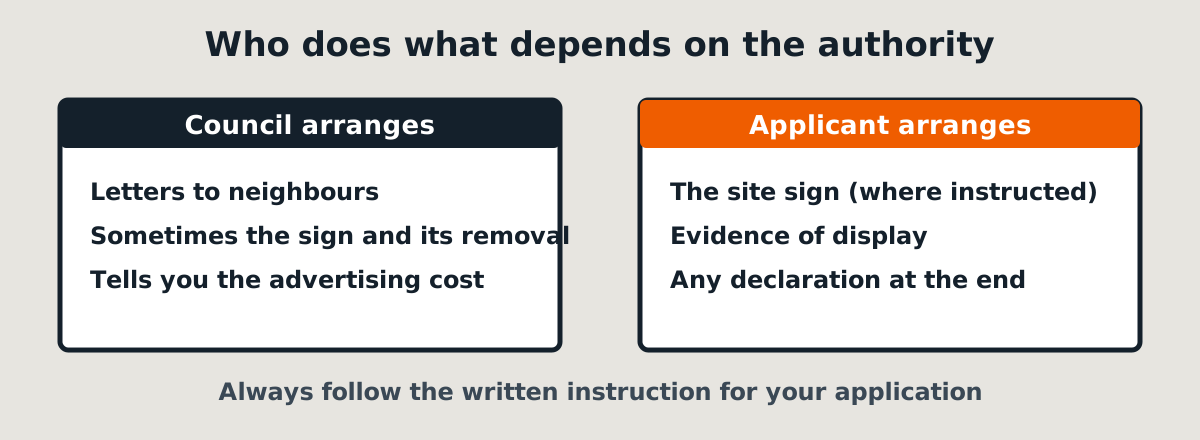
Advertising requirements are set by the authority, and they differ. One council sends letters to neighbours and asks the applicant to put up the sign; another sends contractors to install and remove its own signs. Display periods, evidence requirements and declarations also vary. If you work from another authority's published process, you can end up with the wrong notice, the wrong dates or a sign the council did not ask for.
| If you know… | You can then… |
|---|---|
| The responsible authority | Find its current advertising instructions and contact its planning team |
| The application number | Match the notice file, photographs and declaration to the right application |
| Who carries out each task | Decide whether an installer is needed at all |
If the authority has asked you to arrange the notice, keep its written instruction with the job. When you request a quote, include the authority's name, the application number and the instruction, and we will work from those.
Related: Planning notice installation · Request a quote